
Ecosystem News
TAO halving: what the Bittensor halving changes for your tokens
The TAO halving slows how quickly Bittensor creates new TAO. Understand what changes for your holdings, subnet tokens, and staking rewards.

In this article
The TAO halving, also called the Bittensor halving, cuts the rate at which the network creates new TAO. Your existing TAO balance stays the same.
The first halving happened in December 2025. As of November 2026, the network creates 0.5 TAO per block, down from 1 TAO before that event. These newly created tokens are called emissions. The next one is estimated for December 2029, when the rate falls again to 0.25 TAO per block.
For a holder, the change raises two separate questions: how much new TAO enters the network, and what happens to subnet tokens and rewards. Those follow different rules.
The Bittensor halving slows new TAO issuance
TAO has a maximum supply of 21 million. Halvings slow the creation of new tokens as that limit approaches. The first occurred at an issuance threshold of 10.5 million TAO, halfway to the cap.
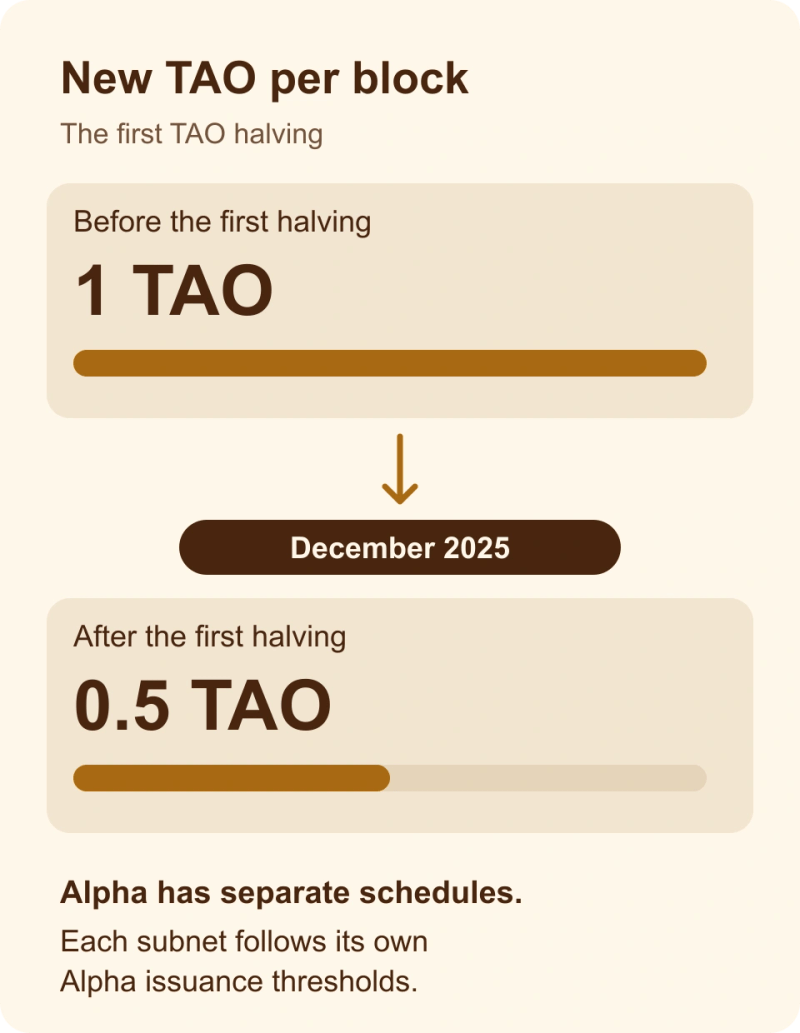
Issuance is the chain's count of tokens created and not recycled. Recycling takes TAO out of that count and makes it available to issue again later. Network transaction fees are one source of recycled TAO.
This is why counting blocks cannot give you an exact halving date. Blocks keep arriving, but recycling reduces the issued total along the way. The halving waits for that total to reach the required amount, which can take longer than a forecast assumed.
If you already hold TAO, a halving requires no wallet action. It changes how quickly new tokens arrive. It does not remove half of anyone's holdings. The TAO guide covers the token's wider role in Bittensor.
The next TAO halving is estimated for December 2029
At the next halving, Bittensor will create half as much new TAO again. The rate will fall from 0.5 to 0.25 TAO per block. That happens once 15.75 million TAO has been issued.
As of 2 November 2026, TaoStats estimates the next TAO halving for 12 December 2029. The date can move as TAO is recycled, so check the current estimate if you are following the timing.
The third halving will cut the amount of new TAO in half again, to 0.125 per block. It happens at 18.375 million TAO issued. Later halvings repeat that pattern: once half the remaining supply has been issued, the rate halves again. New TAO arrives more slowly as the supply approaches its cap.

Subnet tokens have their own halving schedules
A service subnet is a group within Bittensor that rewards people for a particular kind of work, such as storing data. Each has its own token, called Alpha. One subnet's Alpha is a separate asset from another's, with its own supply limit and halving schedule.
If you hold Alpha, a TAO halving does not automatically cut your rewards in half. Each subnet sets aside new Alpha for participant rewards. The subnet halves that rate once it has issued a certain amount of Alpha. Subnets can reach that point at different times. Their Alpha halvings follow their own timelines.
A TAO halving also affects the pools where you swap TAO and Alpha. These hold reserves of both tokens. After the halving, the network adds less new TAO and Alpha to the pools, so the reserves grow more slowly from these additions. These pool additions are separate from the Alpha set aside for participant rewards.
Slower pool additions can also push an Alpha halving further away. Newly created Alpha added to a pool counts towards that subnet's issued total, alongside the Alpha created for rewards. With less new Alpha entering the pool, that total grows more slowly and can take longer to reach its halving point. So the TAO halving can affect when an Alpha halving happens, without automatically cutting the rate of Alpha set aside for rewards.
Your own staking rewards can still change for other reasons, including the subnet and validator you use. Our Alpha-token guide explains how a position receives rewards and what can change them.
Lower issuance does not promise a higher price
A halving tells you something specific about new token supply. Buyers and sellers still determine market prices. Lower issuance alone cannot tell you what your TAO will be worth.
For an Alpha position, keep the token amount separate from its value in TAO. You can receive more Alpha while the TAO value of your position falls. Slower issuance does not remove that price risk.
When checking a position, read any reward rate as an estimate. Then check what you would receive if you exited, including the quote's fees and price impact. The subnet staking guide explains the validator's role and the risks behind an estimated reward rate.
Ready to make a swap?
Open PotaTao, connect your Bittensor wallet, and choose the tokens you want to swap.

Related stories


