
Guides
Bittensor mining: what to check before you start
A practical preflight for deciding whether to mine on Bittensor and checking a subnet's task, requirements, registration, and ongoing work.

In this article
Bittensor mining means running work that a particular subnet rewards. Before you buy hardware or register, check what that subnet asks miners to produce, how validators judge it, and what you could lose if the work does not earn. Each subnet defines its own task and operating code, so the setup changes from one subnet to another.
Some subnets let you solve a proof-of-work challenge to join. Once you join, you earn token rewards, called emissions, for work the subnet's validators score. Mining guide
Before Bittensor mining, check the task
Identify the service first. A subnet might ask miners to provide compute, inference, storage, or another digital commodity. The word "mining" alone does not specify what the machine must do. Find the subnet's current repository and read its task instructions before you compare machines or spend money. Bittensor's documentation overview describes miners as the participants who produce each subnet's digital commodity.
Then ask whether you can run that service for the time and cost it needs. Hardware is only one part. You may need to maintain software, keep a network endpoint reachable, respond to validator requests, and update the service when the subnet changes. If the task or operating requirement is unclear, pause before registering.
Choose a subnet by its task and requirements
Use the subnet's own documentation and repository as the source for the job. Read its README and current hardware documentation for the task and the machine it expects. Check whether the maintainers provide a testnet or local setup so you can learn how the service behaves before registering.
Check how many registration slots are free. Once the subnet is full, a new arrival can displace a miner or validator. The chain normally looks first at registrations whose immunity period has ended and removes the one with the lowest score for emissions earned. If scores tie, the older registration goes first.
If everyone is still within their initial immunity period, the same scoring rule applies to those registrations. The subnet owner's protected hotkey (the key identifying that participant on the subnet) is exempt. Check the subnet's current capacity and immunity period to judge how much time you might have to start earning. Mining guide
Use a hotkey you own for mining. Bittensor's mining guide warns that emissions sent to a subnet owner's associated hotkeys are not paid out as ordinary miner rewards.
Check the full cost of joining
Check which registration methods the subnet allows. If it offers proof of work, you can solve a challenge and submit it directly with a zero tip. That submission has no registration burn, upfront collateral purchase or transaction fee. Any existing collateral stays subject to the subnet's rules. Proof-of-work registration
If you use paid registration, check the price just before you commit. It rises after paid registrations and falls over time. Registration burn guide
Check how much of that payment you could recover. Some subnets burn the whole fee. Others use part of your TAO to buy Alpha, the subnet's token, and lock that Alpha as collateral on your hotkey. Earning emissions on the subnet gradually frees the collateral for withdrawal. If Alpha falls against TAO while it is locked, even a fully released deposit can be worth less TAO than you paid.
Eviction leaves the remaining lock on the hotkey. If you re-register that key on the subnet, the existing collateral counts towards the new requirement. If you quit for good, the balance can stay frozen indefinitely. Some subnets also require a separate deposit before validators will score your work, even if you joined through proof of work. Check the subnet's policy before you budget. Registration collateral guide
If paying the burn and tying up the rest in Alpha would cost more than you can afford to lose, wait before registering.
Understand how evaluation affects rewards
Subnet validators evaluate miner output. They request work through the miner's published network address, or endpoint, then assign scores according to the subnet's incentive mechanism. Those evaluations influence how the subnet distributes emissions. A miner's reward therefore depends on the task, validator scoring, subnet rules, and whether the service remains useful and available. Bittensor's emissions guide explains how validator evaluations feed into participant emissions.
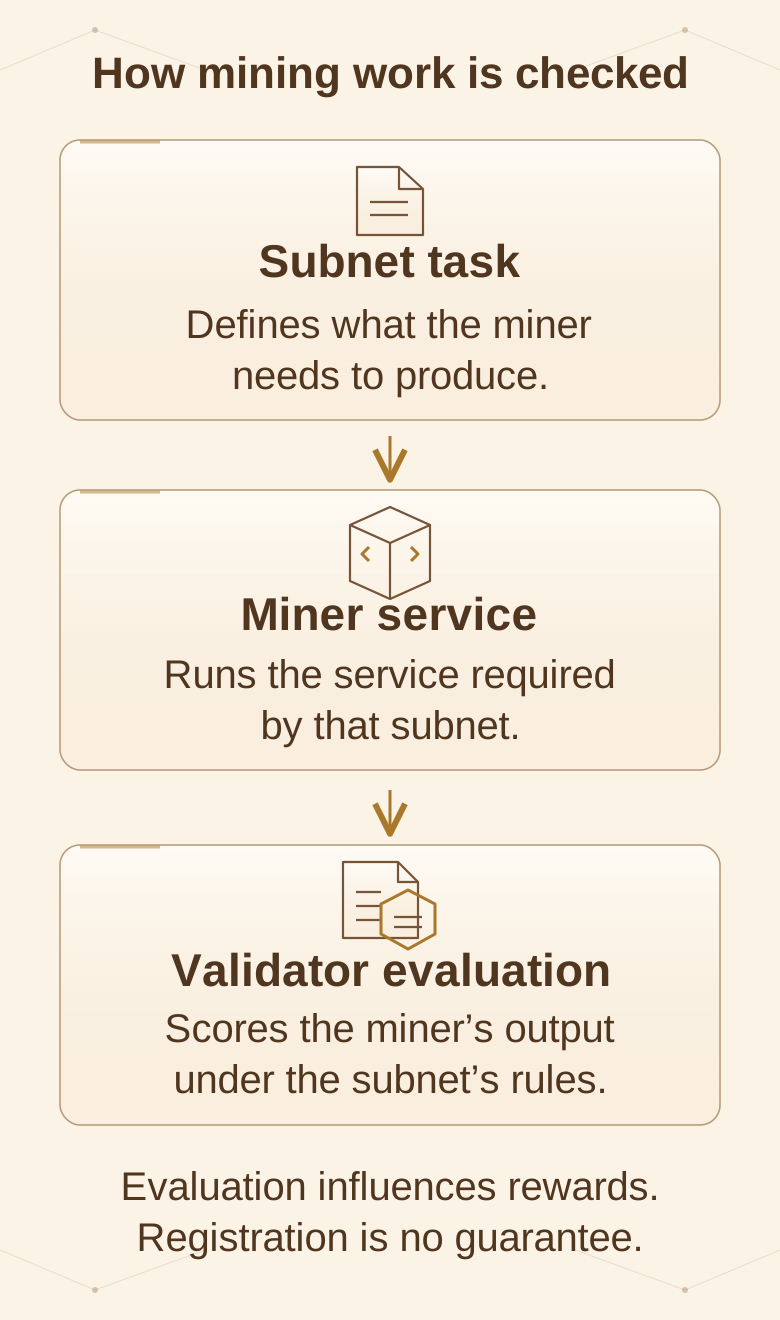
No single reward share applies to every subnet. The subnet owner can configure how its emissions are divided, while validators determine the scores that feed into miner incentives. A miner can be registered and still earn little or nothing if validators do not score its work. Profit depends on what those emissions are worth after hardware, power, hosting, labour, registration, and changes in token value.
Validators may take time to find a new endpoint, and the subnet pays rewards on its own schedule. Check whether your service can answer requests directly. Its last score can still be visible after the machine goes offline.
Plan the operation and protect your keys
Mining needs ongoing attention. Keep the service reachable, watch for software and task changes, and know what signal tells you that validators can no longer use your endpoint. A machine move can require publishing its new address and waiting for validators to switch before you stop the old service.
Keep your coldkey, the key that controls wallet funds, off the mining machine. Subnet software can include large, untrusted dependencies, so the official guide recommends using the miner's hotkey for routine operations and keeping the coldkey somewhere trusted. Do not send private information through a subnet service unless its design and operators give you a reason to trust that path. Requests pass between validators and miners without a general confidentiality guarantee.
A short preflight before you register
Before spending, make sure you can answer these questions from the subnet's current sources:
- What exact task will the miner perform, and how will validators score it?
- Which repository and release should you run, and what hardware does it require?
- Is there a testnet or local way to check the service first?
- Which registration methods are open? If you pay to join, what is the current price and how much is burned or locked?
- Does the subnet require a separate deposit? How much Alpha could stay locked or lose value against TAO?
- How full is the subnet, and which registrations can be evicted?
- Can you keep the service running and monitor it after registration?
- Can you absorb the cost if the miner earns little, is evicted, or you stop operating?
If an answer is missing, ask the subnet team or wait for current documentation. Avoid mining on that subnet for now if you cannot meet its task requirements, keep the service running, or absorb the entry cost and any locked collateral.
For the wider network context, read our guide to what Bittensor is. When you have a subnet in mind, use its current repository and official Bittensor mining documentation for the actual setup steps.
Ready to make a swap?
Open PotaTao, connect your Bittensor wallet, and choose the tokens you want to swap.

Related stories


