
Guides
Dynamic TAO (dTAO): how Bittensor funds subnet emissions
A plain-English account of how dTAO changed subnet funding, how the current price-based allocation works, and how it differs from participant rewards.

In this article
dTAO changed how Bittensor shares new TAO emissions between subnets. Before dTAO, root validators submitted weights that influenced each subnet's share. The original dTAO design proposed using subnet-token prices in TAO pools as the signal. Today's system still uses price, with additional adjustments to the allocation.
This decides how much new TAO flows to each subnet. It does not decide how that subnet later shares its Alpha emissions among miners, validators, and other participants.
Before dTAO, root validators set subnet weights
Root is Bittensor's network-wide subnet. A root validator is a validator registered there. Before dTAO, root validators submitted weights to guide how network emissions were divided across subnets. Validators with more stake had more influence over the combined weights.
The dTAO whitepaper describes this earlier validator-weighting model. The older Bittensor Standard also says root validators manually assigned weights across subnets. Those pages describe the previous system, not today's full allocation formula.
The dTAO proposal used subnet-token prices
The dTAO whitepaper proposed using each subnet's Alpha price in a TAO pool to help set its share of network emissions. Alpha is the token associated with an individual subnet. Trading TAO and Alpha in the pool helps set that price, so the proposed signal came from market activity.
Subnet tokens arrived in a live chain upgrade in February 2025. The current emissions documentation records the transition. The whitepaper explains the original idea, while today's formula includes further changes.
The current dTAO funding path has several steps
The chain starts with the price of each eligible subnet's Alpha in TAO. It smooths prices over time, so a brief spike carries less weight. A higher smoothed price gives a subnet a larger starting share.
Two adjustments can change that share. First, the chain checks how much of the previous reward period's miner incentive went to hotkeys (operating keys) linked to the subnet owner. It withholds those rewards. If half the miner incentive went to those keys, the subnet carries half its starting weight into the next calculation. Both burned and recycled rewards count. If this would wipe out every subnet's weight, the chain falls back to the price shares.
Next, the emission gate cuts smaller weights more sharply. The chain uses the resulting proportions to divide the block's TAO among eligible subnets. Current emissions rules
The V431 change removed Root stake from the calculation between subnets. Root stake still helps determine how much liquidity a subnet can add to its pool and what dividends Root stakers can receive.
Pool funding and participant rewards are separate
Each block, the chain can add TAO and matching Alpha to a subnet's trading pool as liquidity. There is a cap on how much Alpha it can add this way. When the cap binds, the chain uses the remaining TAO allocated to that subnet to buy Alpha from the same pool. The protocol keeps the Alpha it buys.
The Alpha set aside for participant rewards accrues separately. At the end of its reward period, each subnet distributes those rewards according to its own rules and validator scores. Emissions guide
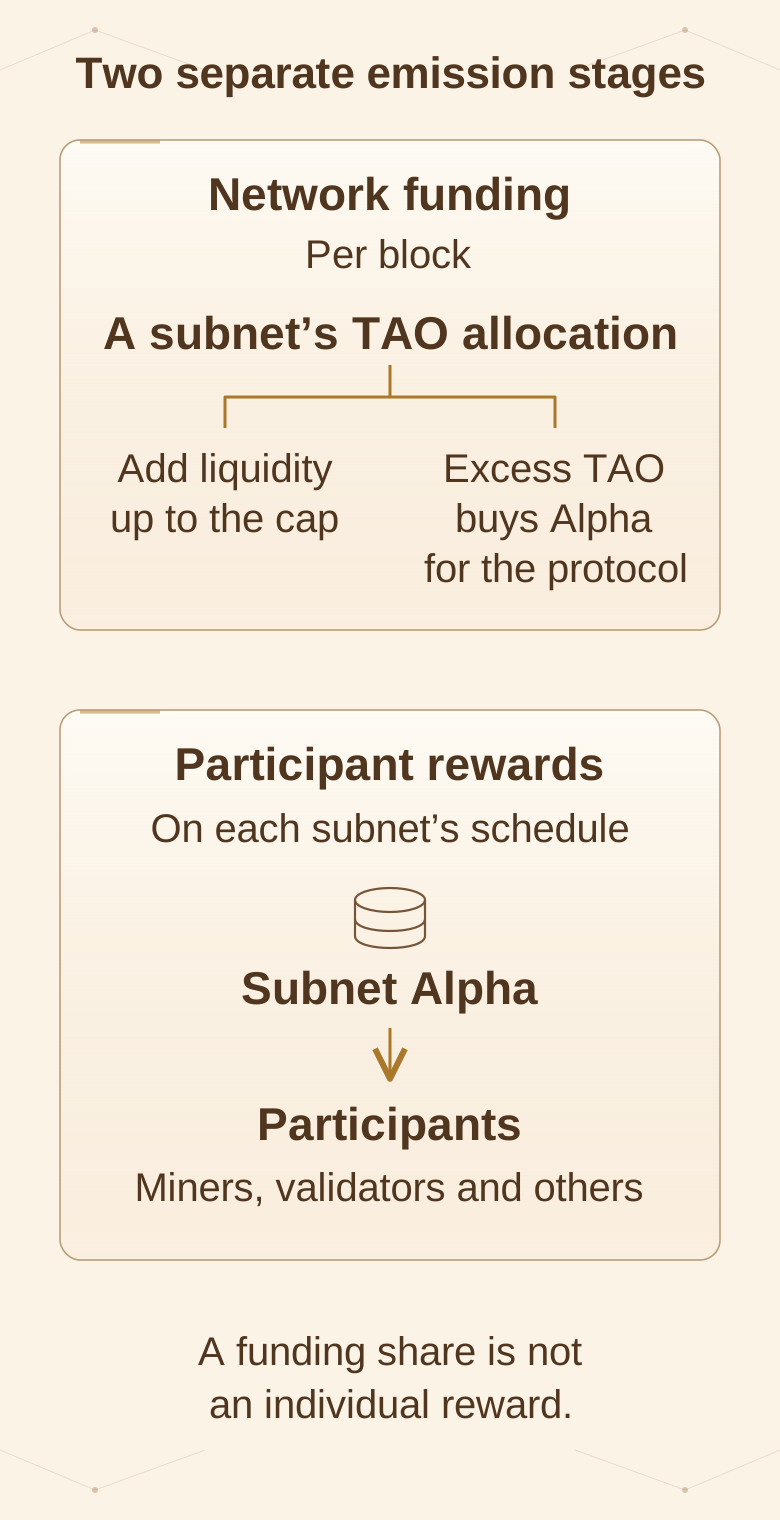
If you're estimating a miner's earnings, start with how its work scores on the subnet and how much Alpha the subnet assigns to miners. The subnet's share of network TAO alone cannot tell you what that miner earns.
For how staking and unstaking affect a pool's price, see our guide to Alpha tokens.
Ready to make a swap?
Open PotaTao, connect your Bittensor wallet, and choose the tokens you want to swap.

Related stories


