
What are Alpha tokens?
Learn what Bittensor Alpha tokens represent, how they are priced, how rewards work, and what risks to understand before taking a position.

Lesson outline
Bittensor Alpha tokens are subnet-specific assets.
Each service subnet has its own Alpha token, so an Alpha position represents exposure to one subnet, not ownership of the Bittensor network as a whole.
The system that introduced these subnet tokens is known as Dynamic TAO, or dTAO. This guide uses “Alpha token” from here.
There is no single token called Alpha across Bittensor. Alpha from one subnet is a different asset from Alpha in another.
TAO belongs to the wider Bittensor network. Alpha belongs to one service subnet.
What Alpha represents
When you stake TAO into a service subnet, the protocol exchanges that TAO for the subnet’s Alpha token.
That means an Alpha position represents:
- Exposure to one specific subnet
- Exposure to that subnet’s liquidity and market conditions
- Exposure to the validator association used for delegated rewards
Your wallet remains the owner of the position. The subnet and validator you choose affect how the position behaves and what rewards it may receive.
Advanced note
The stake is recorded against your coldkey, the selected validator hotkey and the subnet’s numerical identifier, called its netuid.
Each service subnet’s Alpha token has a maximum supply of 21 million and its own halving schedule from the subnet’s launch. Per block, the protocol can create alpha_out for participant rewards and alpha_in for pool liquidity. A young subnet can mint up to one of each per block before its own halving curve and injection limits reduce that rate.
How Alpha gets its price
Each service subnet has an on-chain weighted pool that pairs TAO with that subnet’s Alpha token.
The protocol uses the pool’s TAO reserve, Alpha reserve and current weights to determine Alpha’s spot price in TAO terms. With the default equal weights, the price follows the pool’s TAO-to-Alpha reserve ratio.
That means:
- Alpha’s price can change over time
- Different subnets can have very different Alpha prices
- The price shown in a quote is not permanently locked in before execution
A transaction can also move the pool itself, so the average execution price may differ from the spot price. Service-subnet swaps currently use a default pool fee of about 0.05% of the input amount.

How rewards work
An Alpha position can receive rewards through the subnet’s incentive system.
The network currently allocates TAO emission across subnets using a moving average of each subnet’s Alpha price, adjusted by its miner-burn penalty. Inside each subnet, accumulated Alpha is split 18% to the owner, 41% to miners and 41% to validators with their stakers.
In delegated staking, rewards are linked to the validator associated with the position. A delegated position can receive a proportional share of validator-side dividends after the validator’s current take. The chain default take is 18%, but a validator can set a lower rate.
Rewards settle at the subnet’s epoch. The default tempo is 360 blocks, or about 72 minutes, although a subnet’s current setting can differ.
The result is not fixed. It can change because of:
- Validator performance
- The validator’s take
- Other stake in the subnet
- Subnet emissions
- Protocol settings
- Alpha’s changing value in TAO
A growing Alpha balance does not guarantee a growing TAO value.
Why liquidity matters
Liquidity describes how much TAO and Alpha is available in the subnet pool.
A larger transaction relative to the pool can move the execution price more than a smaller one. That is price impact.
It helps to distinguish three ideas:
- Price impact
Movement caused by your own transaction consuming pool liquidity.
- Slippage
Additional movement caused by the pool changing before your transaction executes.
- Execution limit
A boundary that restricts how much adverse price movement your transaction accepts.
The pool fee is separate from price impact and slippage. Even if a transaction succeeds within its limit, Alpha’s market value can still change afterwards.
Main risks
Alpha creates exposure to both a subnet and a market.
- Subnet risk
The subnet’s service or incentive design may underperform.
- Price risk
Alpha can lose value against TAO.
- Liquidity risk
A thinner pool can create greater price impact and weaker exit conditions.
- Validator risk
Validator performance, availability, and take can change.
- Protocol risk
Bittensor rules can evolve, and a subnet can be deregistered.
If a subnet is deregistered, its UIDs and Alpha market are removed. The pool’s TAO reserve is distributed proportionally across Alpha holders, so the payout can differ from the position’s earlier market value.
Compare the subnet itself as well as its token. A strong-looking price or APY does not remove service, validator, liquidity or deregistration risk.
Entering and exiting Alpha
You get a subnet’s Alpha by staking TAO into that service subnet.
You exit the position by unstaking, which exchanges Alpha back into TAO through the same subnet pool.
Moving from one service subnet to another requires:
- Exiting the first Alpha position through TAO
- Entering the second subnet from TAO
That means both pools can affect the final result.
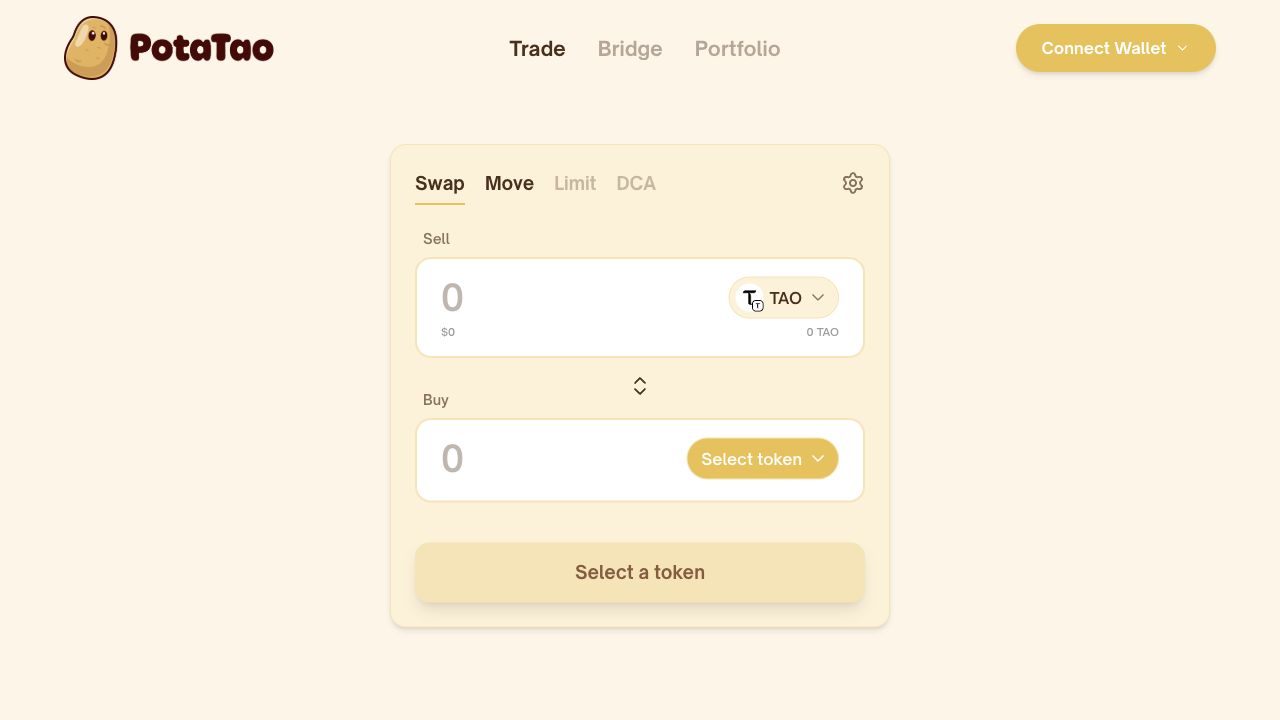
For PotaTao’s current supported flow, follow the TAO-to-subnet-token tutorial.
To understand validator selection, read How to stake TAO in a subnet →. To change the validator linked to a position in the same subnet, read How to move stake between validators →.
FAQ
Is Alpha another name for TAO?
No. TAO is Bittensor’s network-wide token. Alpha tokens belong to individual service subnets.
Is there one Alpha token for the whole network?
No. Each service subnet has its own Alpha token and its own 21 million maximum supply.
Does every Alpha token have the same price?
No. Each service subnet has its own pool, liquidity, weights and market conditions.
Are Alpha rewards fixed?
No. Any displayed rate is an estimate based on current subnet and validator conditions. Rewards normally settle at epoch boundaries, with a default tempo of about 72 minutes.
Does Root Subnet have an Alpha token?
No. Root network, netuid 0, keeps principal denominated in TAO and does not use an Alpha pool.
Can Alpha lose value even if rewards are being paid?
Yes. Rewards and market value are different. An Alpha balance can grow while its value in TAO changes up or down.
Can I move directly from one subnet’s Alpha to another?
There is no single Alpha-to-Alpha market. The route passes through both subnet pools, so the first position is valued through TAO before the second is entered.
Recommended lessons
Keep going
Three useful lessons selected to build on what you have just learned.
Recommended next
How to swap TAO for a subnet token
Use Swap to turn TAO into a subnet’s Alpha token. Choose the subnet, review the quote and validator, then confirm the swap.

Also recommended
How to stake TAO in a subnet
Learn how TAO becomes a staked Alpha position, choose a subnet and validator, and review the details before you confirm.

Also recommended
How to move stake between validators
Move your staked Alpha to another validator in the same subnet—without selling the token or changing subnets.
Ready to use PotaTao?
Open the app, connect your Bittensor wallet, and check every detail before you sign.
