
Security
Bittensor quantum-resistant wallets: what changes for TAO holders
Bittensor quantum-resistant wallets could change how you sign transactions. Understand key rotation, wallet support, and the rollout still to confirm.

In this article
Bittensor quantum-resistant wallets would add ways to authorise transactions designed to withstand a future quantum-computer attack. The proposed change is optional: existing wallets would keep working.
For TAO holders, the immediate question is whether there is anything to change today. On 3 November 2026, the wallet implementation had reached a development branch, but a live rollout was not confirmed. A branch merge alone is no reason to replace your wallet.
Quantum resistance changes how you sign
When you send TAO, your wallet signs the transaction with a private key. That signature lets the network check your authority to spend without revealing the key itself.
A sufficiently powerful quantum computer could break some of the maths used by today's cryptography. NIST says current quantum computers are too small and unstable for those attacks. Nobody knows when a machine capable of them will arrive. Preparing new signature methods takes time, which is why work starts before that threat becomes practical.
The Bittensor design adds ML-DSA and Falcon, two families of signatures intended to resist quantum attacks. You do not need to understand their maths to follow the change: they give the network a different way to check that you authorised a transaction.
ML-DSA is a final NIST standard. Falcon's standardisation is still underway, and the Bittensor proposal does not claim compatibility with its final standard format. Quantum resistance is a security goal, rather than a promise that every implementation detail is settled.
Key rotation could keep your receiving address
The proposal also adds wallets whose signing key changes after an included transaction, while the receiving address stays the same. Your balance, stake, and account history would stay together. This mode is called a hashed wallet.
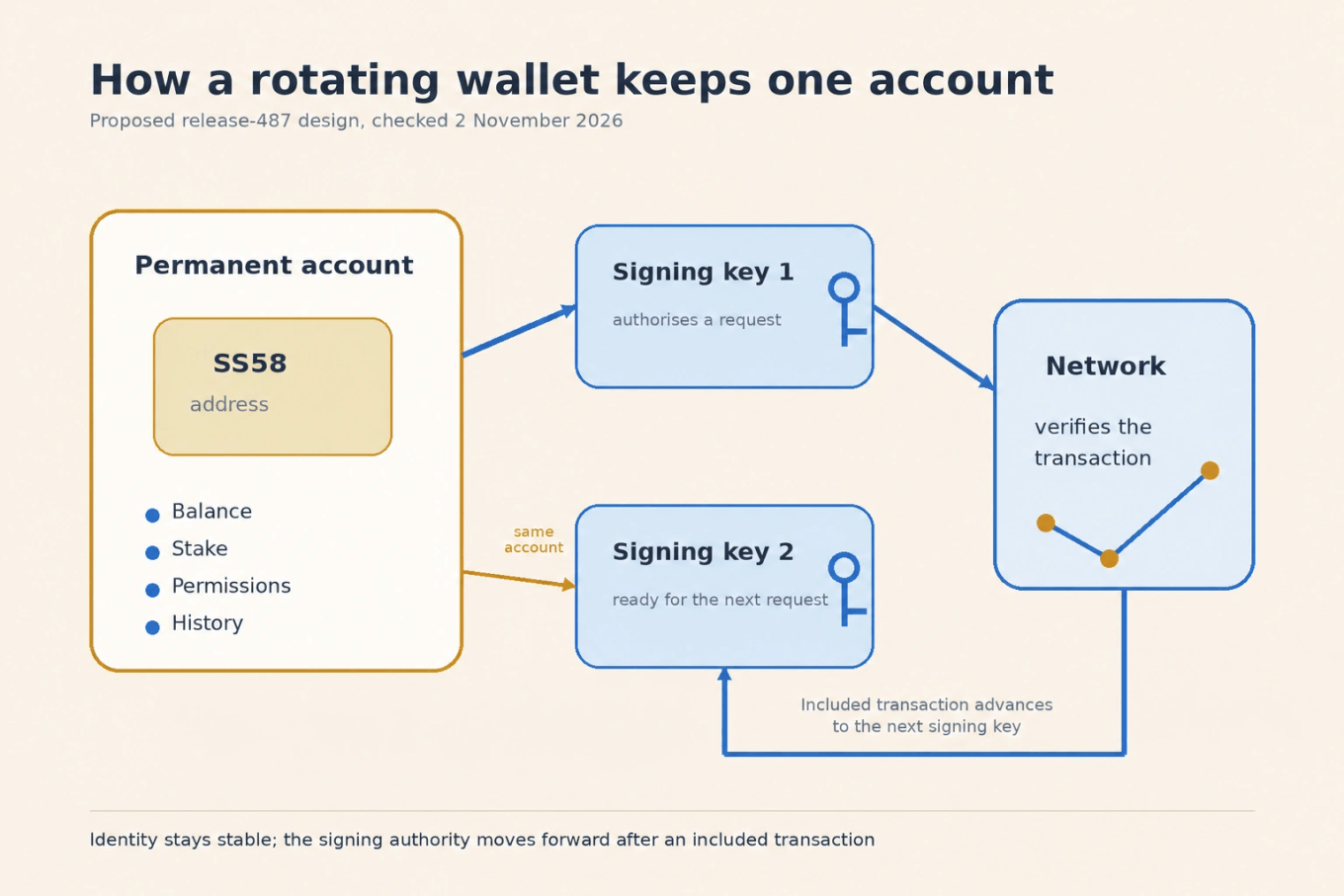
Rotation and quantum resistance do different jobs. Changing a key does not turn an existing signature method into a quantum-resistant one. The new ML-DSA or Falcon method provides that part of the design.
A rotating account would need registration, permanently reserving 0.2 TAO from whoever pays for it. Transaction fees are separate. The proposed ML-DSA and Falcon wallets without rotation would not require that registration reserve.
Release and wallet support still matter
The implementation merged into the release-487 branch on 27 October. A separate change merged into the main branch only raised the version number; it explicitly excluded the wallet implementation.
On 3 November, the broader release request remained open, and the published release list still showed Runtime 486 as latest. The design also has a separate activation switch that defaults to disabled. A published release and activation on the live network are separate milestones.
Your wallet software would then need to support the chosen account type. Existing browser extensions and hardware wallets would not automatically gain the ability to sign with ML-DSA or Falcon. Being able to display a transaction is different from being able to authorise it.
For a shared wallet, the rules for approving payments matter too. It would not become fully quantum-resistant if spending could still be approved with older signature methods alone.
Before considering a change, look for confirmation of the exact wallet code released, its activation on mainnet, and support from the wallet you use. Mainnet is Bittensor's live network, where real TAO moves.
Meanwhile, keep your recovery phrase offline and use official wallet downloads. The Bittensor wallet documentation explains why possession of that phrase gives control over the funds. New signature methods would not stop someone using a stolen phrase or persuading you to sign a harmful transaction.
For the wider context, PotaTao's Bittensor guide explains how wallets and network activity fit together.
Ready to make a swap?
Open PotaTao, connect your Bittensor wallet, and choose the tokens you want to swap.

Related stories


