
Subnets
Chutes AI subnet 64: what it does, costs, and how to buy
Chutes AI is Bittensor subnet 64: serverless compute for open-source models. What it does, what it costs, the risks, and how to buy Chutes Alpha on PotaTao.

In this article
Chutes AI is a place to run open-source AI models without owning a single GPU.
It lives on Bittensor as subnet 64, also written SN64, where miners supply the graphics cards, validators check the work, and an Alpha token tracks the whole arrangement.
Some of the open models behind everyday chatbots and image tools are served through Chutes.
This post explains what Chutes sells, what it costs to use, how the subnet behind it works, what to watch before you buy in, and how to swap TAO for Chutes Alpha on PotaTao.
Chutes at a glance
- Subnet: 64 on Bittensor, token shown as SN64 on PotaTao.
- Service: serverless inference for open-source AI models, sold per request.
- Pricing: pay as you go from a topped-up balance, with optional monthly plans.
- Alpha token: exposure to this one subnet, earned by miners and validators and tradable against TAO.
- Figures in this post: read on 4 September 2026 and re-checked on publication day.
Chutes sells compute by the request
Open-source AI models are free to download. Running them is not.
A modern language model needs expensive hardware, and keeping that hardware warm all day costs money whether anyone is using it or not.
Chutes takes that problem off the developer. You send a request to an API, a model somewhere on the network answers it, and you pay for what you used.
Chutes calls this serverless compute in its documentation. The developer never rents a machine or installs drivers. The catalogue labels each model Hot or Cold, Chutes' own signal of whether it is already running or will be started on demand.
The catalogue covers more than text. Image, video, speech, and music models sit alongside the large language models, and a developer can package their own code as a Chute if the catalogue lacks it.
Chutes says it serves trillions of tokens a month and lists OpenRouter, Kilo, Fetch.ai, and Phala among the products routing traffic through it. Those are the company's figures, not ours. What we could check is that OpenRouter listed Chutes as a provider with six models on 4 September 2026.
There are consumer products too. Chutes Chat and Chutes Search put the same models behind an ordinary interface for people who do not write code.
What Chutes costs to use
Chutes does not currently advertise a free plan on its pricing page. The entry point is pay as you go: you top up a balance and each request draws it down.
Two optional subscriptions sit above that. Plus is $10 a month for a bundled daily quota and a 6% discount on requests beyond it. Pro is $20 a month for a larger quota and 10% off. Enterprise pricing is arranged through sales.
The per-request prices are small. On 4 September 2026 the catalogue listed Qwen3 32B at $0.10 per million input tokens and $0.42 per million output tokens, with larger models priced at a few dollars per million.
Developers who want a model running privately pay by the hour for a dedicated GPU, plus a one-off deployment fee equal to three hours of that rate. Prices and the catalogue change often. Treat these as a snapshot.
The subnet turns GPUs into a marketplace
Every Bittensor subnet is a market for one kind of work. On Chutes, the work is running AI applications.
A Chute is a single application, packaged with everything it needs to run. Think of it as one small web service with a model inside.
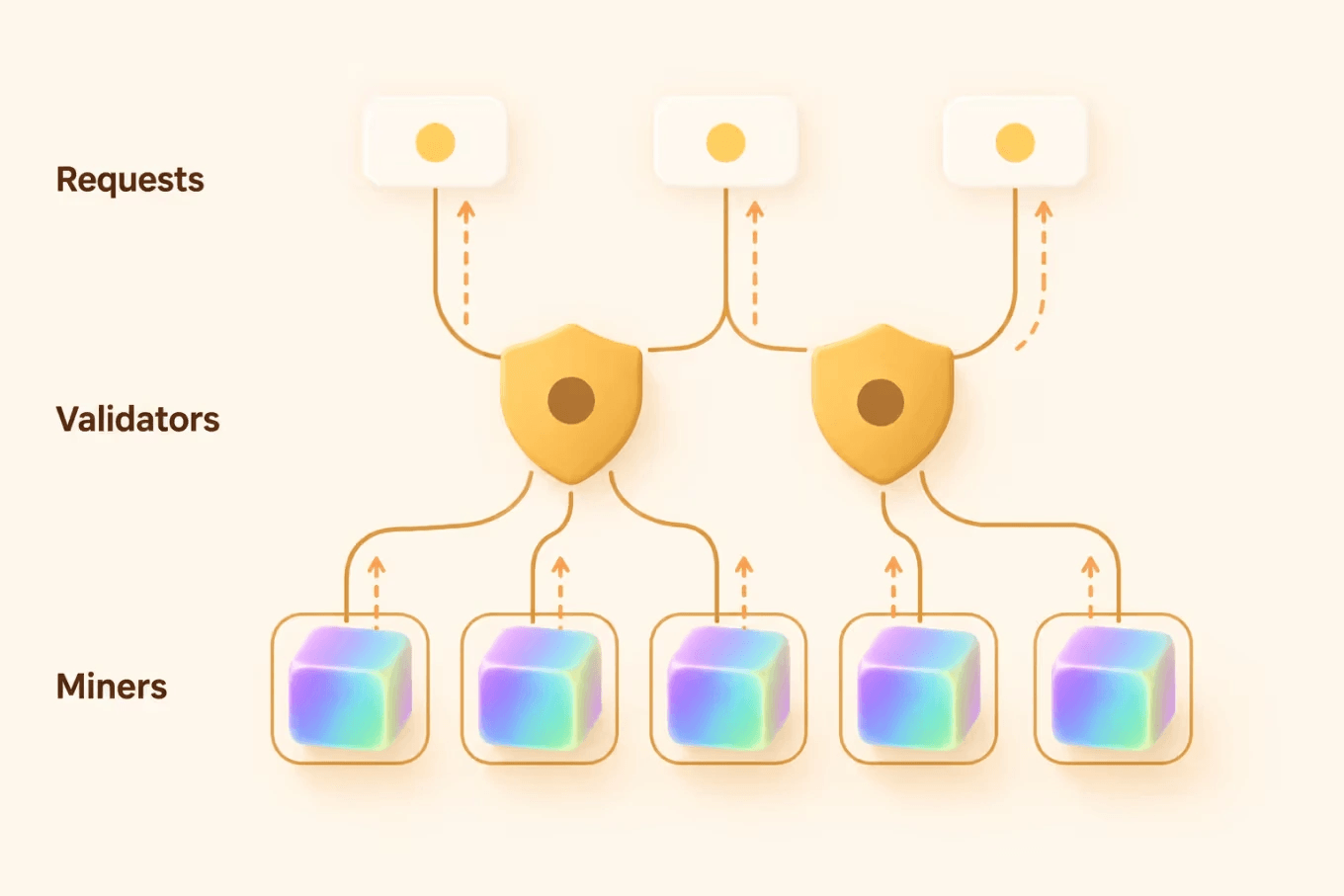
Miners are the people who own the graphics cards. They run a control plane that receives Chutes from the network and keeps them alive on their hardware. The more useful capacity a miner offers, the larger their share of the subnet's rewards.
Validators run the platform's API and check that miners are doing what they claim. A request comes in, a validator routes it to a miner, and the response is scored.
Chutes says that since 2026 every GPU node runs inside an Intel TDX confidential virtual machine, a design intended to isolate the code, the model, and the user's prompt from whoever operates the machine. The older method, a library called GraVal that tested cards with maths puzzles, is no longer accepted.
The detail matters for one reason. A miner on Chutes needs specific server-grade hardware, not a gaming card in a spare room. That raises the quality of the network and raises the cost of joining it.
Rewards follow the same split as every subnet
Bittensor shares new TAO between subnets from a moving average of each subnet's Alpha price, then adjusts each share by how much miner incentive that subnet withheld in the previous cycle. Inside the subnet, the reward is split three ways: 18% to the subnet owner, 41% to miners, and 41% to validators and the people staking with them.
Chutes' share of that emission was about 12.5% on 4 September 2026, one of the higher shares on the network. The exact figure and the order of subnets change daily.
Because the split is fixed by the protocol, the question for a Chutes miner or validator is not how much the subnet earns. It is how much of the subnet's 41% they can win. That is decided by the subnet's own scoring, which the team publishes on GitHub.
If you hold Chutes Alpha without running anything, your position sits on the validator side of that split. How to stake TAO in a subnet explains how a delegated position earns and what a validator's take does to it.
A team that ships in public
Chutes' own team page lists ten people, with Jon Durbin under Backend. The command-line kit's README still points to repositories under a Rayon Labs organisation, which is where the project's code began.
The code is where the activity shows. The chutesai organisation on GitHub holds 50 public repositories. On 4 September 2026 the validator and API code had been updated the day before, the miner tooling five days before, and the confidential-compute host tooling that same day.
The command-line kit is MIT licensed. Most developers reach Chutes through the hosted API rather than the kit, so its 90 stars undercount the audience.
Chutes by the numbers
The figures below were read on 4 September 2026 from two market trackers and from PotaTao's own quote. Trackers count slightly differently and the order of subnets changes within a day, so treat every number as a snapshot, not a ranking.
- Chutes Alpha price: 0.0743 TAO per token on PotaTao at 14:59 UTC.
- Market cap: between about 434,000 and 454,000 TAO across the two trackers. At that day's TAO price of around $230, roughly $100 million.
- Where that sits: among the largest subnets by market capitalisation, within a few percent of lium.io, with the two trading places during the day.
- Traded in the previous 24 hours: 972 TAO, per taostats at 12:15 UTC.
- Share of network emission: about 12.5%.
Volume alone does not tell you what a trade will cost. PotaTao shows an estimated price impact on every quote, and that figure is the one to read before you confirm.
What to watch before you buy
A subnet's Alpha is exposure to one project, not to Bittensor as a whole. What are Alpha tokens covers the mechanics. Chutes adds three points of its own.
First, the hardware bar. Confidential compute is designed as a security gain for users, and it also narrows the field of miners to those who can afford the right servers. A smaller set of miners is easier to coordinate and easier to lose.
Second, the validator side. The team suggests that most people delegate to its own validator through a child hotkey rather than run a full validator, which is practical advice and also a concentration of influence. There is a lighter-weight audit tool for those who want to check weights without running the platform.
Third, the market. Chutes competes with centralised inference providers that do not need a token at all. Its edge is the newest open models arriving quickly and running in sealed hardware. Whether developers keep paying for that edge is the question the Alpha price answers, one day at a time.
These are the questions a careful buyer asks first.
How to buy Chutes Alpha on PotaTao
PotaTao is a non-custodial interface. It prepares the swap, your wallet approves it, and the transaction happens on Bittensor. PotaTao never holds your tokens.
- Open app.potatao.io and select Connect Wallet.
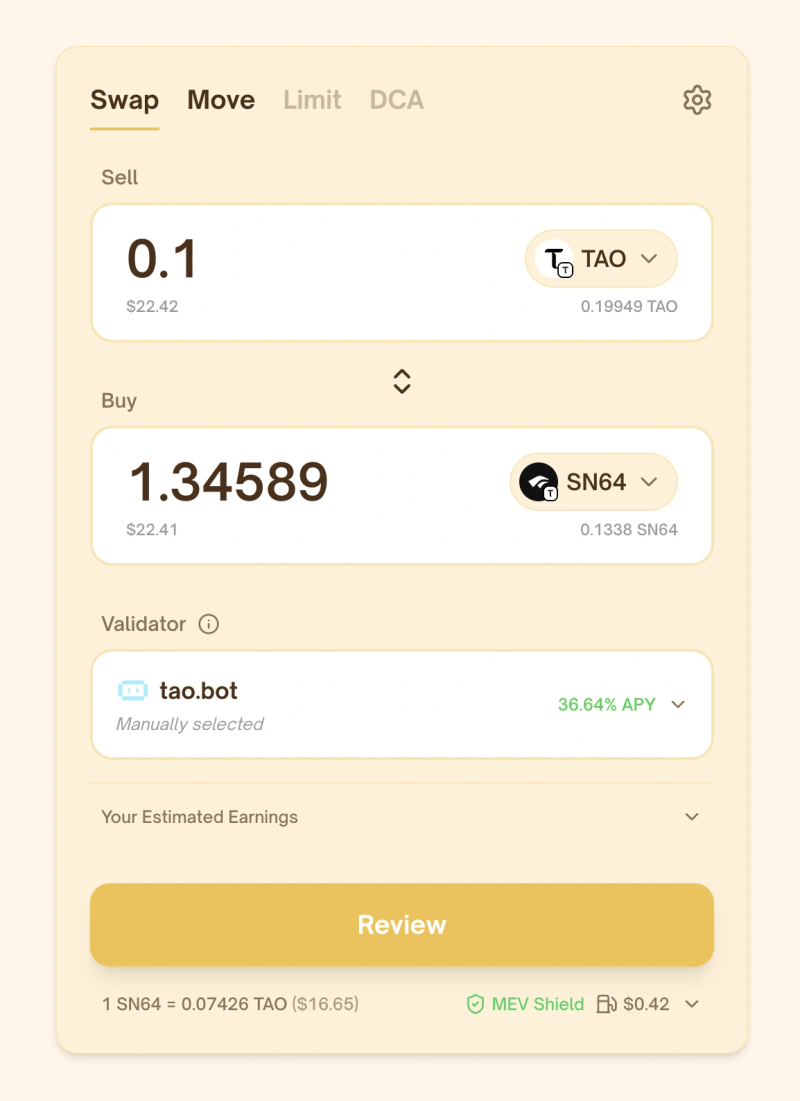
- In the Buy field, open the token selector and choose SN64, Chutes.
- Enter the amount of TAO to sell. The estimated SN64 you would receive, the current rate, and the estimated fee appear.
- Check the validator shown for the position and its estimated APY, and confirm MEV Shield is on for this swap.
- Select Review, check every value, and approve the request in your wallet.
Check the quote before you confirm. Alpha prices move, every estimate is an estimate, and MEV Shield helps protect supported swaps without removing every risk. What MEV protection does explains the limits.
Understand the subnet before you decide whether to swap.
Ready to make a swap?
Open PotaTao, connect your Bittensor wallet, and choose the tokens you want to swap.

Related stories

