
Subnets
Decentralized compute: what you get and what you trust
Decentralized compute can give you a machine, a model API or a completed job. Understand control, privacy and what the network actually checks.

In this article
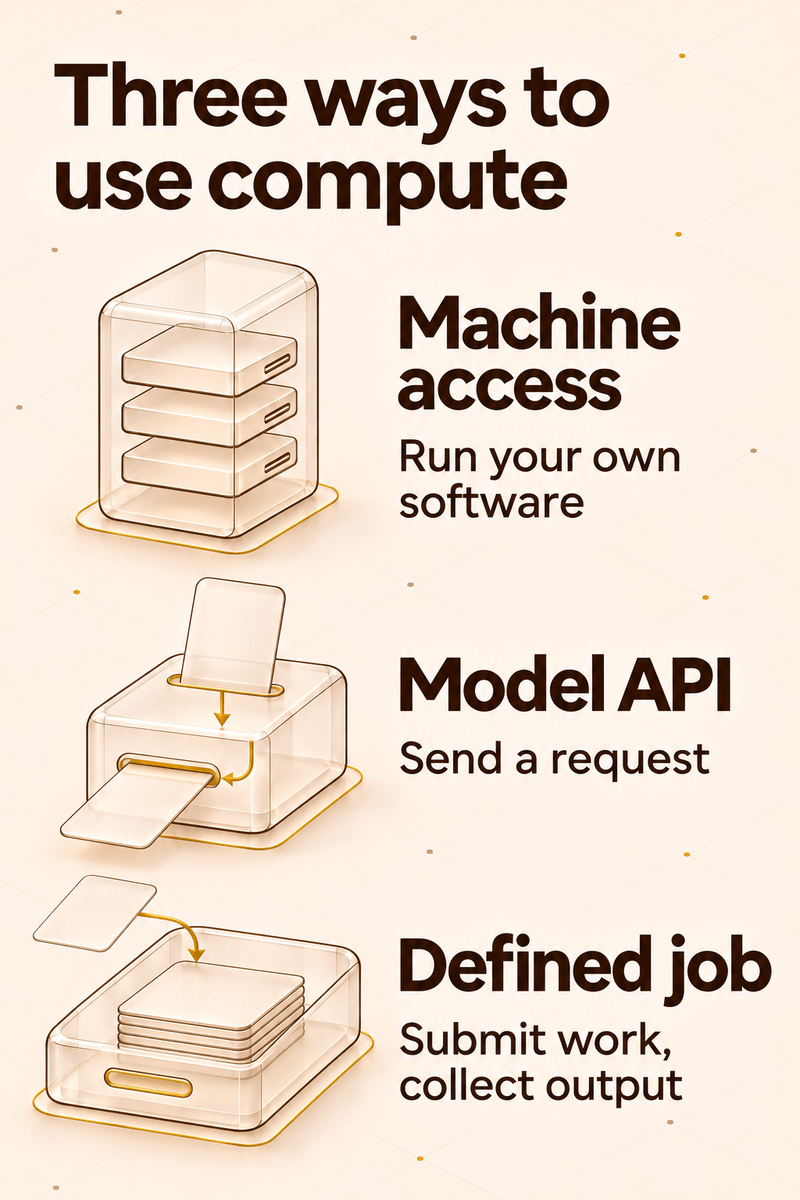
Decentralized compute supplies computing power through a network of providers. What you receive depends on the service. You might rent access to a machine, send a request to an AI model, or submit a job and collect its result.
Those choices leave you with different responsibilities. Renting a machine lets you choose the software it runs. A hosted model can answer requests without you managing the machine underneath. A job service takes a defined piece of work to execute. The network's name alone does not tell you which arrangement you are getting.
On Bittensor, subnets organise different kinds of digital work. Lium, Chutes, Targon and ComputeHorde show how varied compute services can be, even within the same ecosystem. Comparing them starts with the work you need done.
Choose how much of the work you want to manage
Suppose you want an AI model to summarise a public report. If a service already hosts a suitable model, you can send the report through its API, the interface software uses to make requests. The service runs the model and returns a response. Running a trained model this way is called inference.
Chutes's model catalogue is one example of that experience. You choose a model and use its calling instructions. For this use, the service handles the machines and returns model responses. You still need to check whether the model's answer is useful and accurate for your purpose.
If you want to change the software around a model or run your own setup, machine access gives you more control. Lium describes a pod as a GPU rental with remote access. A GPU is a processor often used for AI work. You connect to the rented environment, put your software there and run it. That also leaves you responsible for configuring the software and keeping its results.
You might want to run a model that a fine-tuning service has trained further on examples of your task. Before you rent a machine, check that you can download the files you need to run it. Our guide to choosing an LLM fine-tuning service explains which files you might receive.
Some work has a clearer hand-off: send a defined task and receive the output. ComputeHorde provides GPU resources for Bittensor validators, the participants that assess work on subnets. It lets them send computation tasks to other providers. That is a specific example of job execution for validators, rather than an ordinary public computer-rental service.
These are ways of using compute, not fixed boxes for companies. Chutes also supports custom deployments. Targon offers several forms of access, including short-lived workspaces, virtual machines and dedicated physical servers. One platform can meet different needs through different products.
Check who can read the work while it runs
A rental gives you control over your software, but the machine still belongs to someone else. Whether that owner can inspect your data depends on the protection built into the selected service.
Lium's renter overview separates ordinary machines, where the hardware provider may access your work, from confidential machines with encrypted memory. Its detailed privacy guide explains the limits. After the required verification, the protection keeps the hardware provider out of the virtual machine's memory and disk. Lium's own software still runs inside that environment. The graphics card's memory and its connection to the main processor are not covered, so private GPU work needs separate checks.
Targon's virtual machines are another example of a service designed around hardware-backed confidential computing. Its guide also labels VMs as beta and warns of possible data loss. A privacy feature and a recovery plan answer different problems; you need to understand both before relying on the machine.
For a hosted model, check the service's current privacy terms and the protection on the particular model or deployment you use. A distributed supply of GPUs does not, by itself, tell you who can read a prompt, where it is logged or how long it is kept. The public-report example avoids private information, but the same decision becomes more demanding with customer records.
Ask what a verification actually proves
Compute networks need ways to check their providers. The useful question is what each check establishes.
ComputeHorde describes hardware-specific test tasks intended to check that providers deliver the advertised computing power. Lium also describes attestation for confidential machines. Attestation is evidence about the environment running your work. For Lium, that evidence checks the machine itself, not the particular rental or software you run on it.
Those checks address parts of service delivery. A check of the GPU does not, on its own, show that the software produced the result you wanted. Evidence about a protected environment does not establish that an AI summary contains no mistakes. A completed job can still be unhelpful if your instructions were wrong.
For the report summary, you would still compare the answer with the report. For other work, ask what result the service checks and what you must check yourself. Look for the scope of the verification before relying on a broad description such as verified compute.
Decentralized compute still needs a recovery plan
The choice of service also changes how you recover when something stops. On a rented machine, progress may be tied to that running environment. Lium's Spot tier allows interruptions without compensation, and its recovery guidance advises keeping results outside the pod.
If your work takes hours, check how to save progress somewhere separate and resume it on another machine. A provider penalty or billing pause does not restore work you never saved.
For model requests or submitted jobs, check how the service reports failure and whether a retry repeats work that already completed. You need to know where the result will appear and how long it remains available. These are part of choosing the service, even when you never see its machines.
Owning a subnet's Alpha token is a separate decision from arranging access to its compute service. Start with the product you need, then check its account, payment and usage terms. Our individual guides to Lium, Chutes and Targon explain those projects in more detail.
Ready to make a swap?
Open PotaTao, connect your Bittensor wallet, and choose the tokens you want to swap.

Related stories


